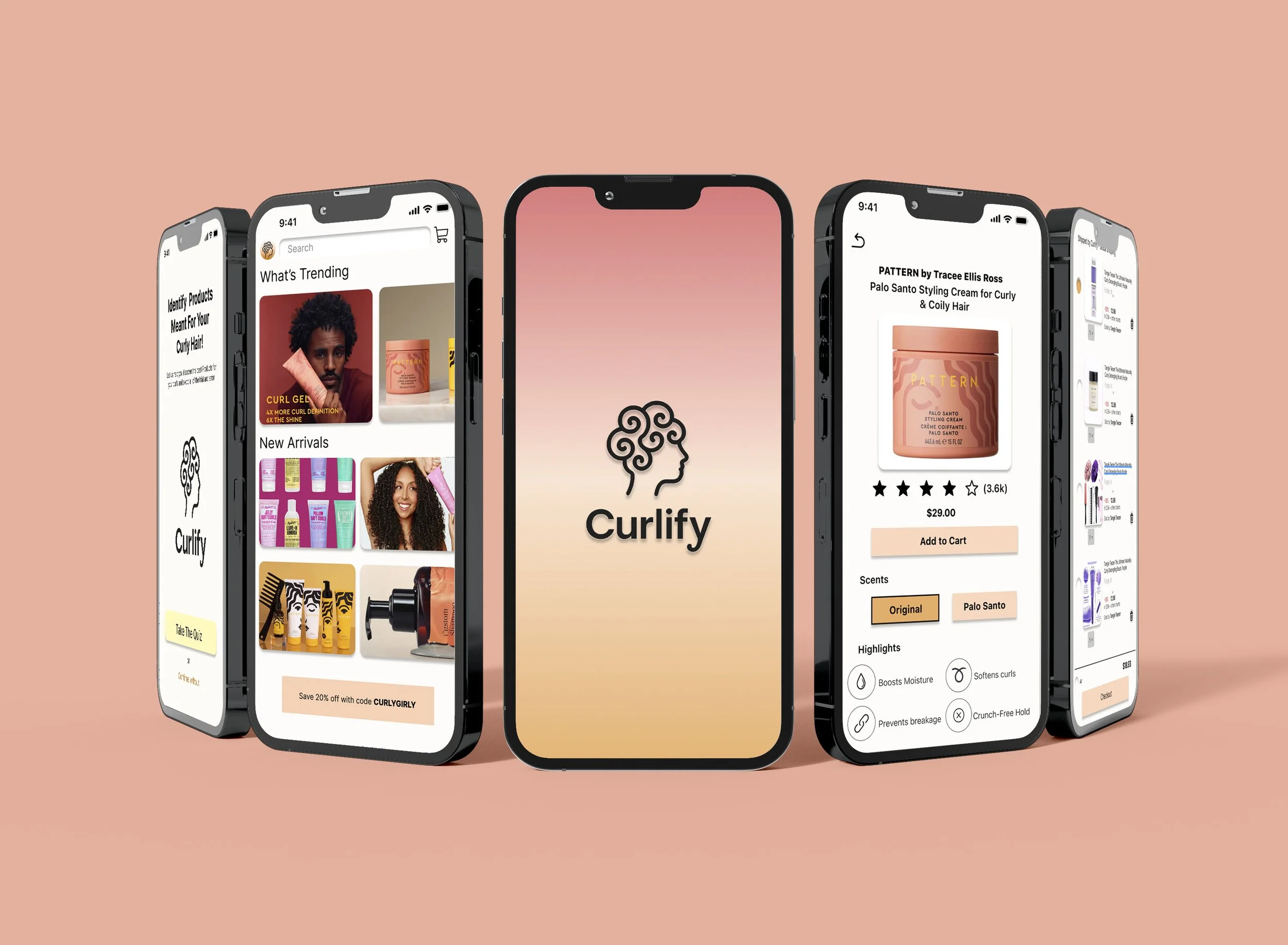
Curlify
Designing a seamless, AI-powered experience that helps users understand and care for their natural curls with confidence.
As one of my personal explorations, I created Curlify, an AI-powered hair analysis app that scans curl patterns and provides personalized product + routine recommendations.
I worked as the UX/ designer, conducting research, building user flows, wire-framing, prototyping, and usability testing to refine both the interaction design and personalization system.
PROBLEM
What problem am I trying to solve?
Users have no reliable way to understand their curl type or choose the right products for their hair online.
Curl Confusion❓
Many users don’t know their exact curl pattern, porosity, or density leading to trial and error.
Product Overwhelm😡
Many users don’t know their exact curl pattern, porosity, or density leading to trial and error.
Frustration +
Wasted Money💰
Many users don’t know their exact curl pattern, porosity, or density leading to trial and error.
This led me to design based off of a guiding question:
INITIAL RESEARCH
Understanding & Sympathizing
“How would we help people confidently understand their curls and build the right routine without trial, error, or product waste?”
Why is the problem important?
Many users with curly and textured hair struggle to find products that actually work for them, leading to frustration, wasted spending, and inconsistent results.
In fact, over 80 % of women with curly or coily hair report purchasing products specifically for their textured hair, often trying multiple products before finding ones that work highlighting how real and widespread this trial-and-error behavior is.
An intuitive, trustworthy AI hair-analysis tool could help reduce guesswork and make shopping for textured hair products online more confident and effective.
Source: beautycon.com
Who am I solving for?
Target Audience 👯♀️
Individuals aged 16–35 with curly, coily, or wavy hair who regularly purchase hair products online, especially those seeking personalization, education, and convenience in their haircare journey.
Market Insight 📈
With the rapid growth of the textured-hair care market and the rise of online beauty shopping, personalized digital experiences are becoming a key differentiator.
Consumers don’t want generic quizzes anymore, they expect intelligent tools that analyze their unique hair patterns and want them to provide routine-level recommendations.
PROBLEM STATEMENT
“As someone with textured hair, I struggle to find products that actually work for me because I don’t fully understand my curl pattern or hair needs.”
UX RESEARCH
Ideation and Research
Competitive Analysis
I started by conducting an in depth, annotated audit of 8+ digital haircare experiences including SheaMoisture, Pattern Beauty, Function of Beauty, Sephora, and more.
I evaluated each platform based on:
Clarity of onboarding and instruction
Depth of personalization (AI vs. static quiz)
Time to completion
Confidence in recommendations
Integration between education and shopping
I conducted user-centered research focused on the lack of accessible, effective, and sustainable hair care solutions for people with curly hair. I defined the problem through both qualitative and quantitative research, examining how mainstream hair care brands and salons fail to prioritize the unique needs of highly textured hair and curly hair. My research explored barriers such as limited product availability, lack of stylist training, higher exposure to harmful ingredients to people with tighter curl textures, and the added cost of sustainable options.
Task Flows
To support different user types (first-time vs. returning, scanner vs. learner vs. shopper), I mapped out multiple task flows within the Curlify ecosystem.
These flows helped streamline the experience across key features including AI hair analysis, the educational scroll feed, and the personalized in-app shop. Mapping different entry points allowed me to identify friction points and ensure users could seamlessly move between discovering their curl profile, learning about their hair, and purchasing recommended products.
DESIGN PROCESS
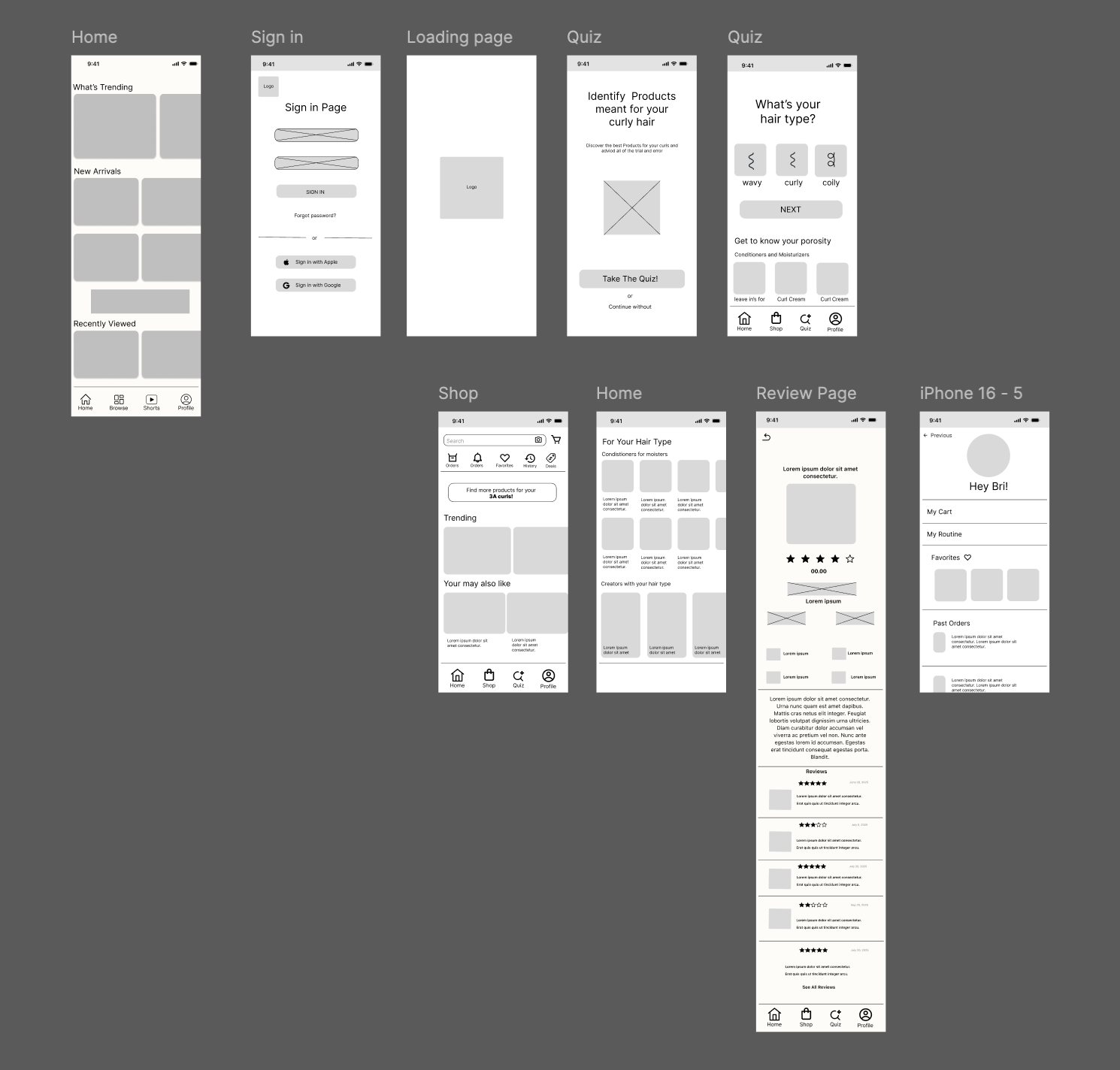
Low fidelity wireframe
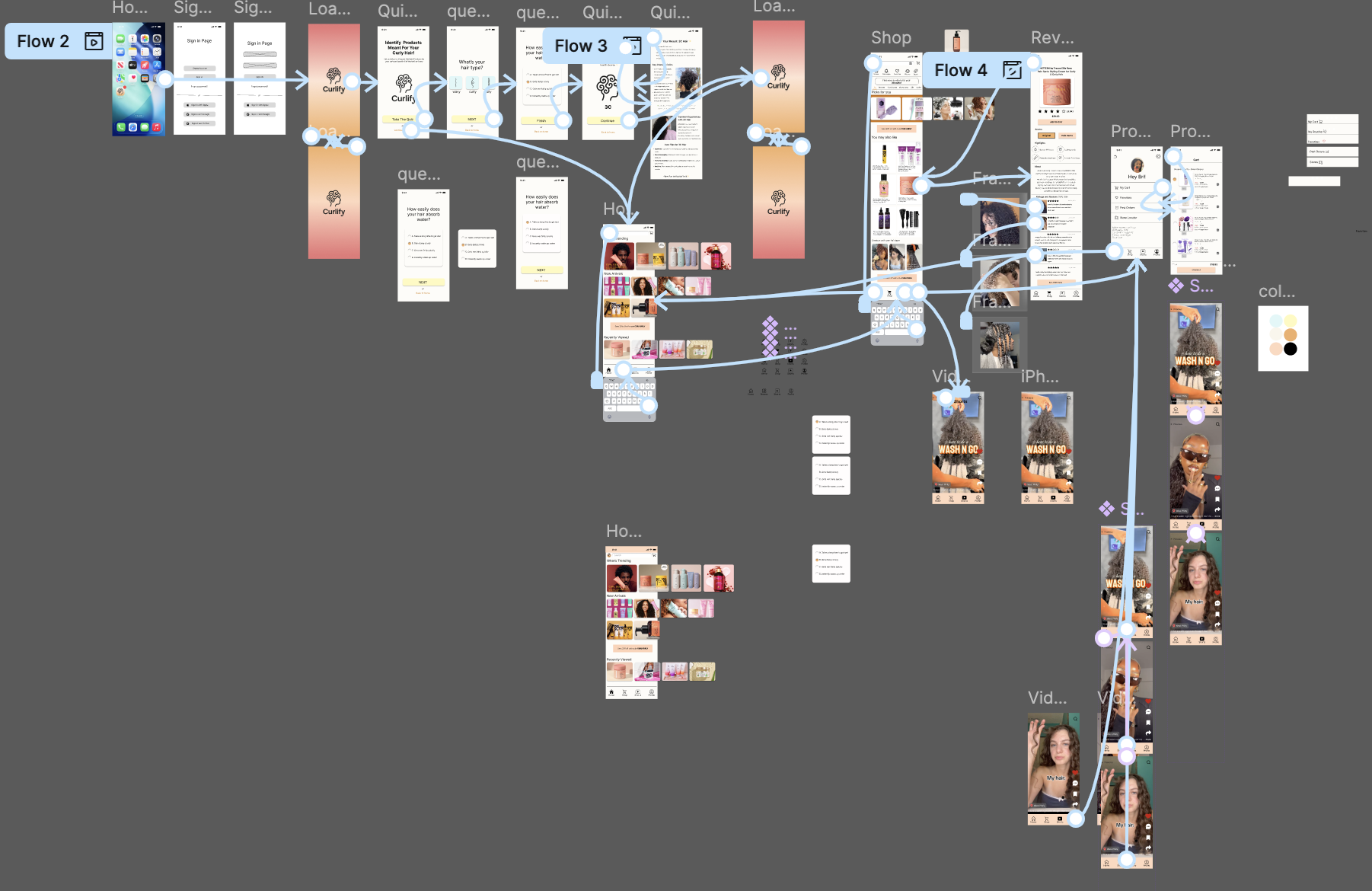
Hight fidelity Prototype
TAKEAWAYS
Things that I learned
This project showed me that great UX in beauty isn’t just about aesthetics, it’s mostly about identity and trust. For any product in beauty the goal is to helps users feel seen, understood, and confident in their journey.
Next Steps
In future iterations, I would conduct moderated usability testing to validate the clarity of the onboarding quiz, the educational feed navigation, and the transition from personalized results to product purchase.
I would also refine the recommendation logic by introducing deeper personalization layers, like routine tracking, evolving hair goals, and product performance feedback over time.
From a systems perspective, the next phase would focus on defining the AI recommendation model more clearly, I would refine the UI system, and map user inputs to product suggestions and improve the educational feed to increase retention and repeat engagement.